ARTISTS
Xin Song: Chaos And Belief
鈥淐haos and Belief,鈥� a midcareer solo exhibition by Beijing-born, New York-based artist Xin Song, challenges every preconception viewers might have about Chinese papercutting. A folk art form with a roughly 2,000-year history, cutting paper into intricate abstract patterns or stylized representations of people, flora, animals, or mixed scenes, is a traditional way of decorating walls and window, giving small gifts, and marking special occasions such as holidays, birthdays, or anniversaries.
Like all forms of 鈥渇eudal鈥� cultural legacy, this practice was suppressed or neglected during the Cultural Revolution (1966-76), when Socialist Realism was the one-and-only officially sanctioned art style in China. Only after the death of Mao Zedong, when both traditionalism and experimentation reemerged, did papercutting win recognition as a modern-art practice.
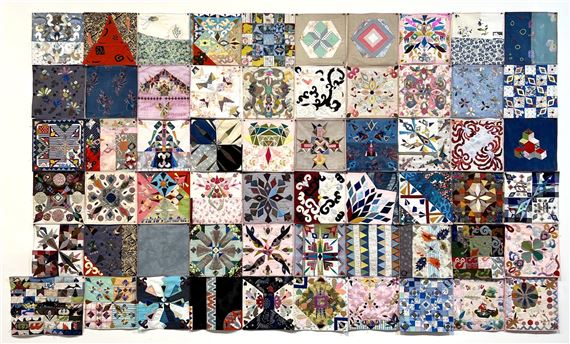
Curated by art critic Richard Vine, 鈥淐haos and Belief鈥� is a compact survey of Song鈥檚 recent work, emphasizing both its formal diversity and its playful yet deeply serious intent. The selection reveals that Song鈥檚 most popular works鈥攖hose that highlight quilt-like patterns or floral motifs鈥攕tand halfway between the two poles of her ongoing artistic concern. One is the emotional turmoil at the center of our psychic life, personal and collective; the other is our capacity for altruistic commitment. Thus images of flowers, stylized waves, and decorative abstractions share the gallery space with a huge, turbulent installation whose twisting and curling paper streamers seem to explode from the wall. Offsetting this visual outburst is an orderly display of cutout portrait heads of some of the artist鈥檚 moral heroes鈥擟he Guevara, Aung San Suu Kyi, Hilary Clinton, Bruce Lee, Laozi, and others.
The complexity of Song鈥檚 vision places her in dialogue with other practitioners of global contemporary papercutting. Her work is edgier than that of Britain鈥檚 comforting Rob Ryan鈥攖he paper strips in some of Song鈥檚 earlier innocuous-seeming compositions were cut from porn magazines鈥攂ut not as directly confrontational as Kara Walker鈥檚 classic antiracist silhouette nightmares. Song鈥檚 installations, which fill and animate large spaces, resonate with the cardboard extravaganzas of Thomas Hirsh, and both artists owe a debt to the modernist master Kurt Schwitters and his legendary Merzbau. Jess and many other 20th century collagists are clearly antecedents, and some viewers might detect a hint of painter Charles Burchfield in Song鈥檚 jittery, vibrating way of constructing organic forms.
In her opening-night performance, Song will rapidly, volcanically, fill an entire wall with cut and pinned paper. This galvanizing act, a living m茅lange of materiality and force, combines elements of Western performance art and Happenings with the longstanding East Asian belief that an artist can be a medium for the flow of the cosmic-organic energy known as qi.
Recommended for you
鈥淐haos and Belief,鈥� a midcareer solo exhibition by Beijing-born, New York-based artist Xin Song, challenges every preconception viewers might have about Chinese papercutting. A folk art form with a roughly 2,000-year history, cutting paper into intricate abstract patterns or stylized representations of people, flora, animals, or mixed scenes, is a traditional way of decorating walls and window, giving small gifts, and marking special occasions such as holidays, birthdays, or anniversaries.
Like all forms of 鈥渇eudal鈥� cultural legacy, this practice was suppressed or neglected during the Cultural Revolution (1966-76), when Socialist Realism was the one-and-only officially sanctioned art style in China. Only after the death of Mao Zedong, when both traditionalism and experimentation reemerged, did papercutting win recognition as a modern-art practice.
Curated by art critic Richard Vine, 鈥淐haos and Belief鈥� is a compact survey of Song鈥檚 recent work, emphasizing both its formal diversity and its playful yet deeply serious intent. The selection reveals that Song鈥檚 most popular works鈥攖hose that highlight quilt-like patterns or floral motifs鈥攕tand halfway between the two poles of her ongoing artistic concern. One is the emotional turmoil at the center of our psychic life, personal and collective; the other is our capacity for altruistic commitment. Thus images of flowers, stylized waves, and decorative abstractions share the gallery space with a huge, turbulent installation whose twisting and curling paper streamers seem to explode from the wall. Offsetting this visual outburst is an orderly display of cutout portrait heads of some of the artist鈥檚 moral heroes鈥擟he Guevara, Aung San Suu Kyi, Hilary Clinton, Bruce Lee, Laozi, and others.
The complexity of Song鈥檚 vision places her in dialogue with other practitioners of global contemporary papercutting. Her work is edgier than that of Britain鈥檚 comforting Rob Ryan鈥攖he paper strips in some of Song鈥檚 earlier innocuous-seeming compositions were cut from porn magazines鈥攂ut not as directly confrontational as Kara Walker鈥檚 classic antiracist silhouette nightmares. Song鈥檚 installations, which fill and animate large spaces, resonate with the cardboard extravaganzas of Thomas Hirsh, and both artists owe a debt to the modernist master Kurt Schwitters and his legendary Merzbau. Jess and many other 20th century collagists are clearly antecedents, and some viewers might detect a hint of painter Charles Burchfield in Song鈥檚 jittery, vibrating way of constructing organic forms.
In her opening-night performance, Song will rapidly, volcanically, fill an entire wall with cut and pinned paper. This galvanizing act, a living m茅lange of materiality and force, combines elements of Western performance art and Happenings with the longstanding East Asian belief that an artist can be a medium for the flow of the cosmic-organic energy known as qi.
Artists on show

What's on nearby